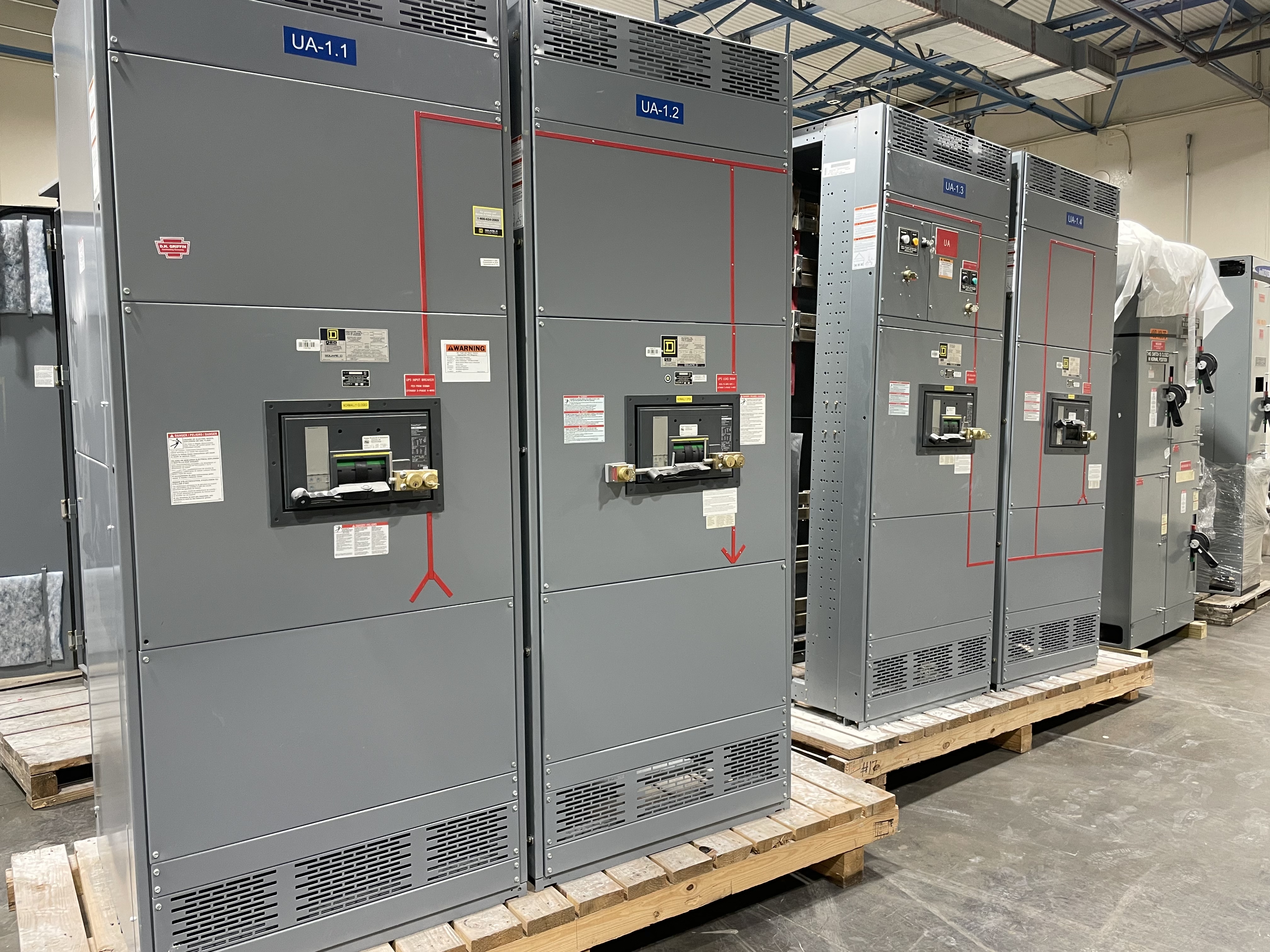
Establish what the 3,000 A marking describes
Start by recording the exact wording and location of every legible rating label. “3,000 A” could identify an assembly, a particular device, or a frame rating; those are not interchangeable descriptions. A breaker’s frame rating is distinct from its trip rating, and neither alone establishes the assembly’s usable load or application. Note whether the marking is on the main assembly nameplate, a breaker label, or another component. Do not reinterpret abbreviations or fill in missing values. A buyer can assess the documented configuration, but should not be asked to infer performance from one number.
Build a section-by-section inventory
Count the sections and describe their arrangement using records or exterior views taken from authorized safe positions. For example, distinguish a documented lineup of several connected sections from a single section listed as part of a larger assembly; do not assume the rest is present. Record visible section identifiers and any safely readable labels, preserving spelling and punctuation. If the original drawings identify mains, ties, or feeder sections, include that terminology as documented rather than assigning functions from appearance. A section count helps clarify scope, but does not establish completeness, internal condition, or compatibility with another system.
Separate device, frame, and trip information
When records identify a breaker, transcribe its device designation, frame marking, and trip marking as separate fields. A 3,000 A assembly does not prove that every installed breaker has a 3,000 A trip, or that a frame marked 3,000 A is set to that value. If a trip detail is absent or unreadable, report it as unknown instead of deriving it from a frame label. Do not remove covers or access equipment to find hidden markings. These distinctions help a buyer review what is actually documented without implying a load, rating relationship, or acceptance.
Describe storage history with useful limits
Summarize known storage history in dated, factual terms: when the assembly was decommissioned if recorded, whether it remained assembled, and any documented indoor or outdoor storage periods. Separate firsthand records from estimates, and identify gaps. For instance, a file may establish the date equipment entered storage but not every condition since then. Do not describe gear as tested, operational, or service-ready unless appropriate records support that statement; seller testing is not required. Storage history informs an individual assessment, but does not establish internal condition or guarantee that the equipment will be purchased.
Share dimensions only when already documented
If existing drawings, inventory sheets, or prior measurements provide estimated load dimensions, label them as estimates and state their source and units. Distinguish overall lineup length from individual section dimensions, and note whether a recorded height or depth includes projections or attached components if the record says so. Do not approach or handle equipment to obtain measurements. These details can help frame a possible logistics review, but they do not establish weight, lifting points, access clearance, or transport requirements. If a measurement is missing, say so plainly rather than supplying a visual guess.
Keep voltage and application questions open
Record the exact nominal-voltage marking separately from the 3,000 A rating, along with any other legible assembly or device ratings. Do not infer voltage from appearance, a breaker marking, or a description such as “main distribution.” A buyer considers equipment across all voltage classes, but that does not establish universal compatibility or acceptance for a particular system. If records conflict—for example, one document lists a different voltage than the nameplate—share both and identify their sources. The mismatch is a question for individual review, not a reason to select one value or claim a suitable application.
Prepare a safe, decision-useful offer inquiry
Provide ownership or authority-to-sell information, the transcribed labels, section count, available records, known storage history, and existing dimension estimates. Safe photographs should show only accessible exterior nameplates and equipment, taken from authorized safe positions; never approach, open, test, disconnect, or move energized equipment for documentation. Electrical work must be performed by qualified, authorized personnel under site rules. The buyer assesses assets individually and may offer cash with upfront payment; no acceptance, price, or timetable is assured. No seller testing or preparation is required. If a purchase proceeds, buyer-paid freight may include crane, rigging, disconnects, loading, and hauling, as applicable.