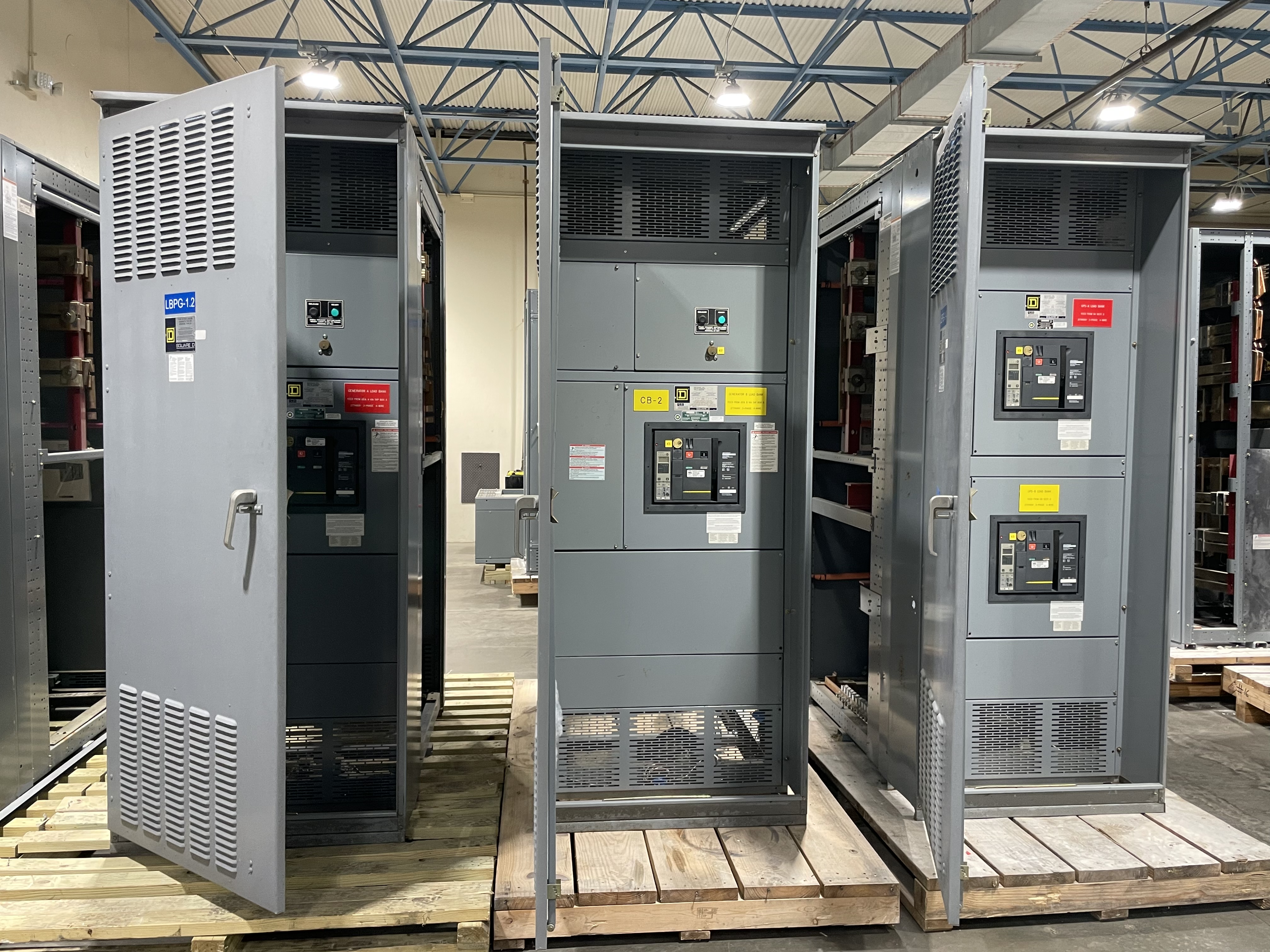
Start with the marking, not the headline rating
Record the nameplate exactly as printed, including commas, units, voltage, frequency, and any qualifiers. A marking of 4,000 A on an assembly does not establish that every breaker in it is rated 4,000 A, or that a particular device has a 4,000 A trip. Keep the assembly nameplate, individual breaker labels, and any frame or trip markings in separate notes. For example, a lineup might carry an assembly ampere rating while its main device has distinct frame and trip values; those are different data points, not interchangeable descriptions. Do not derive missing ratings from appearance, adjacent labels, or a catalog match.
Separate equipment identity from replacement need
A switchgear replacement decision involves more than matching the largest ampere number. The proposed replacement may depend on system voltage, configuration, protective devices, available fault-current information, and site-specific design requirements. A 4,000 A assembly marking cannot establish compatibility with the equipment being replaced, nor show what the connected installation requires. If replacement planning is underway, have the responsible electrical design and operations personnel define those requirements independently. For a sale assessment, provide the equipment identity and condition information that is safely available, while keeping design approval separate. Neither a buyer’s interest in the surplus asset nor its nameplate rating should be treated as engineering confirmation or a substitution recommendation.
Keep load data distinct from nameplate amperes
Load records answer a different question from an equipment rating. Historical demand, operating schedules, or measured current may help qualified site personnel understand how an installation has been used, but they do not revise a nameplate rating or establish what a replacement must support. Conversely, a 4,000 A marking does not prove the equipment has carried that load. If you have relevant records, identify their source and period rather than presenting them as a rating. Do not conduct new measurements for a sale inquiry or approach equipment to gather information. Any electrical inspection or measurement belongs to qualified, authorized personnel working under site rules and appropriate controls.
Document safely without disturbing the lineup
Useful sale documentation can be limited to exact transcriptions and photographs of safely accessible exterior nameplates, taken only from an authorized safe position. Never approach, open, touch, operate, test, disconnect, remove, rack out, or move energized equipment to obtain a label or image; do not ask site staff to do so for a buyer. Note whether a marking belongs to the assembly, a breaker, its frame, or its trip unit, and flag anything unreadable rather than guessing. If a label is inaccessible, say so. Photos should not reveal restricted information or require crossing barriers. Qualified personnel must handle any work needed to make equipment safe or expose identification.
Coordinate release timing with the removal route
The available release date and the physical route are separate planning constraints. A lineup could be cleared for release on a known date yet remain difficult to remove because of narrow doorways, low overhead clearance, stairs, a long haul to the loading area, or other equipment occupying the path. Conversely, a clear route does not mean the asset is ready for release. Share the expected date range, access hours, floor or loading constraints, and any known route restrictions for review; do not move barriers or equipment to investigate. Crane and rigging needs, disconnects, loading, freight, and hauling require site-specific coordination. Electrical work must be performed by qualified authorized personnel under site rules.
Request an individual assessment, not a rating-based promise
We buy used, surplus, and decommissioned electrical equipment, including assets from decommissioned data centers and shut-down power plants, across all voltage classes. For a 4,000 A switchgear inquiry, provide the transcribed markings, available condition notes, ownership or authority to sell, release timing, and removal constraints. No seller testing or preparation is required. We assess each asset individually; the ampere marking alone does not determine acceptance, price, or replacement suitability. If an offer is made, we provide cash and pay upfront. Buyer-paid freight and arrangements for crane, rigging, disconnects, loading, and hauling can be considered as part of the individual review, without requiring sellers to hire crews or perform electrical work.