A practical buyer for a hospital or campus closure
Closure work rarely follows a neat equipment-room sequence. A hospital may need to maintain essential clinical areas while buildings are released in stages. A college or university campus may have several electrical rooms, residence halls, laboratories, athletic facilities, or central utility areas with different shutdown dates. A seller may be an owner, facilities department, receiver, contractor, or asset manager, but the first decision is the same: confirm who is authorized to sell the equipment and which portions are actually being released.
We purchase used, surplus, and decommissioned electrical equipment rather than asking you to find another end user. The inventory can include switchgear that has been removed and stored, as well as equipment scheduled for removal after qualified de-energization. We also buy switchgear from decommissioned data centers and shut-down power plants. All voltage classes are considered. Age, incomplete records, or a changed operating plan do not by themselves require the seller to prove performance before requesting an offer.
Separate the asset decision from the closure plan
Hospitals and campuses often have overlapping stakeholders. A facilities leader may control access, an owner may control title, a construction manager may control the sequence, and a compliance or security team may control visits. Put the selling authority and the site contact in writing before pickup is scheduled. If a building is leased, confirm that the equipment belongs to the party offering it. If a project involves several buildings, identify each building, room, lineup, and release date rather than combining everything into one uncertain description.
That separation also prevents an electrical sale from being confused with unrelated demolition. We are buying the electrical equipment identified for sale; the seller remains responsible for any broader building, structural, interior, or other project work outside the equipment transaction. If a closure has separate environmental or hazardous-material requirements, disclose those conditions early so the scope is clear. Do not open cabinets, remove covers, operate breakers, or handle energized equipment to prepare an inventory.
What to record without testing
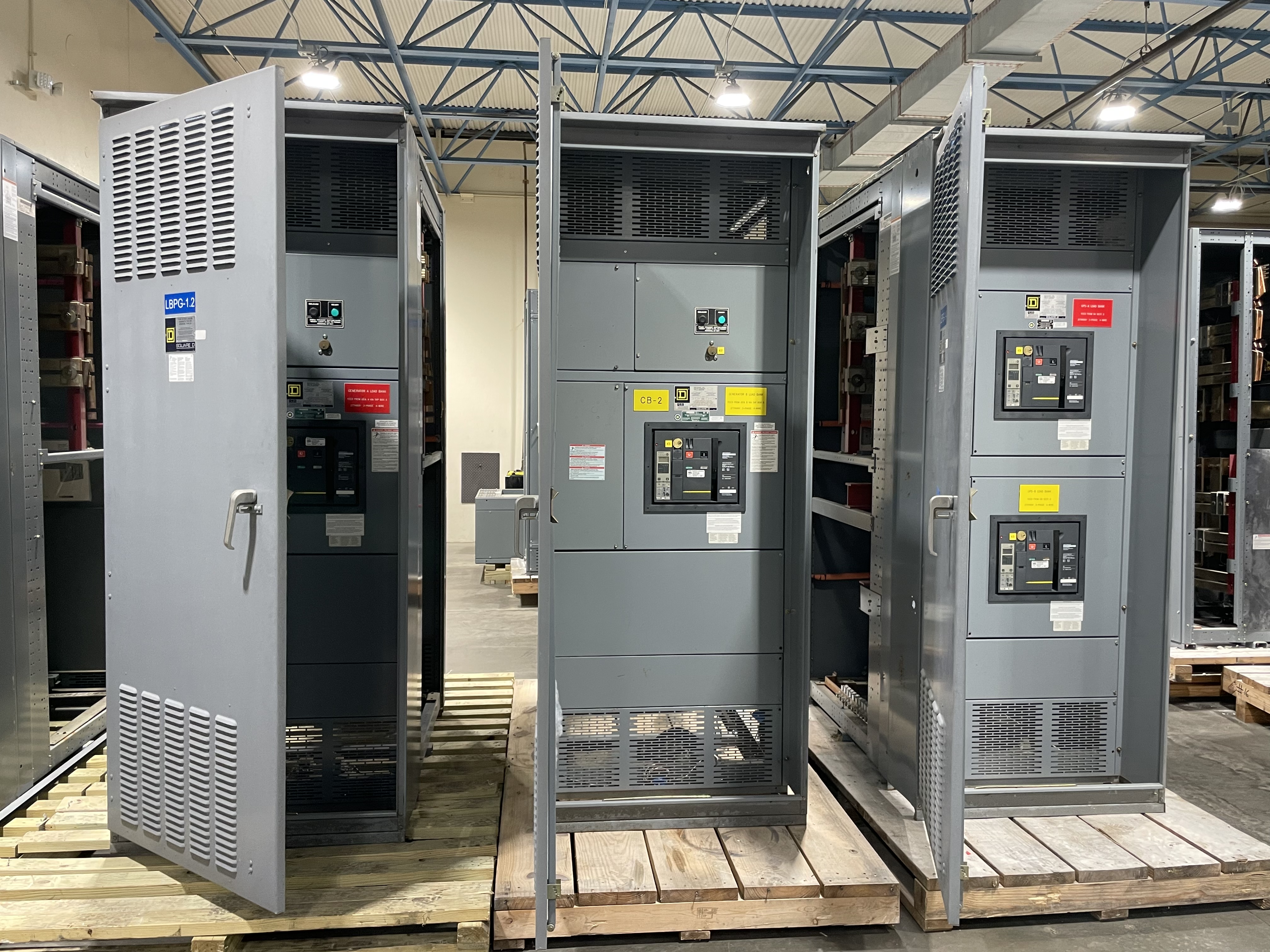
- Exterior photographs of each lineup, cabinet, breaker, transformer connection, or loose component, taken only from a safe location.
- Visible nameplate information such as manufacturer, model, serial number, voltage, ampere rating, interrupting rating, and section count when legible.
- Whether equipment is installed, disconnected, palletized, crated, or stored, and whether sections are complete, separated, or missing obvious parts.
- The building or room identifier, approximate dimensions, access route, floor level, and any known door, elevator, dock, or receiving restrictions.
- Known exposure to water, weather, impact, contamination, or storage conditions, described plainly rather than as a claim about operability.
Unknown details are acceptable. A clear photo of an exterior label and a candid note that records are missing are more useful than guessed specifications. A lineup can be reviewed as a group, while loose breakers, relays, control components, bus sections, and spare parts should be listed separately when possible. Do not promise that a partial assembly has the same value or application as a complete lineup; accurate identification lets us review the actual lot.
Plan staged release around continuity and access
For a hospital, the release date must follow the facility’s own continuity and safety plan. A retired lineup may sit beside equipment that still supports patient-care areas, backup systems, laboratories, or building services. For a campus, one building may be empty while another remains occupied, and academic calendars, events, security windows, or restricted deliveries may affect the pickup sequence. Tell us which equipment is already safely disconnected and which remains in place pending qualified electrical work. We will coordinate the next step rather than asking a seller to improvise.
Our qualified personnel handle electrical disconnects when required, along with crane work, rigging, loading, freight, and hauling. Sellers do not need to arrange a separate crane company or load the equipment themselves. Electrical work is handled by qualified personnel, and sellers should never open or handle energized equipment. Your role is to provide authorized access, identify site rules, share available information, and approve the release. We can then plan the removal around the agreed window and the physical conditions at the site.
Full-service logistics for difficult equipment rooms
Switchgear can be heavy, tall, awkwardly positioned, or connected to a lineup that cannot be treated as loose scrap. Before dispatch, we need practical access information: the route from the room to the loading point, thresholds or stairs, dock availability, overhead clearance, turning space, security check-in, and whether a crane or specialized rigging approach may be needed. A simple floor plan or exterior access photograph can prevent a mismatch between the equipment and the removal plan.
We coordinate disconnects, rigging, lifting, loading, freight, and hauling as one service. That matters during a closure because the seller is often balancing a building handover, a contractor schedule, and limited staff availability. Once the sale and release are agreed, our team handles the physical logistics so you are not left with equipment at a loading dock or a freight booking to manage. Share restrictions early, including quiet hours, infection-control procedures, campus escorts, badge requirements, or a requirement to protect adjacent rooms. We will use those details to coordinate the work; we will not ask unqualified personnel to perform electrical tasks.
Payment and the next conversation
We offer cash for qualifying used, surplus, or decommissioned equipment and pay upfront according to the agreed transaction. There is no seller testing requirement. Start with the inventory you can safely document, even if the hospital or campus closure is still being phased. Include the equipment location, ownership contact, anticipated release window, visible labels, and access conditions. That gives us a grounded basis for reviewing the lot without inventing a condition report or a guaranteed price.
The outcome should be a clear division of responsibility: the authorized seller confirms what is available; qualified personnel handle electrical and removal work; our logistics process handles crane, rigging, loading, freight, and hauling; and the seller gets paid without taking on unnecessary equipment handling. Whether the equipment comes from a hospital closure, a university campus consolidation, a decommissioned data center, or a shut-down power plant, send the available details and we can discuss the next step.
DECOMMISSIONING / THE COMPLETE SERVICE
From shut-down site to paid seller.
We buy electrical switchgear from decommissioned data centers and shut-down power plants. We handle all rigging and logistics: crane, rigging, disconnects, loading, freight and hauling are on us. Qualified personnel handle electrical disconnects and isolation according to site safety procedures. The seller does nothing but get paid.
We make cash offers, pay upfront, require no testing from the seller, and buy all voltage classes. Share the site and equipment details you know; photos are helpful only when they can be taken safely. Never open or touch energized equipment or disturb a live installation.