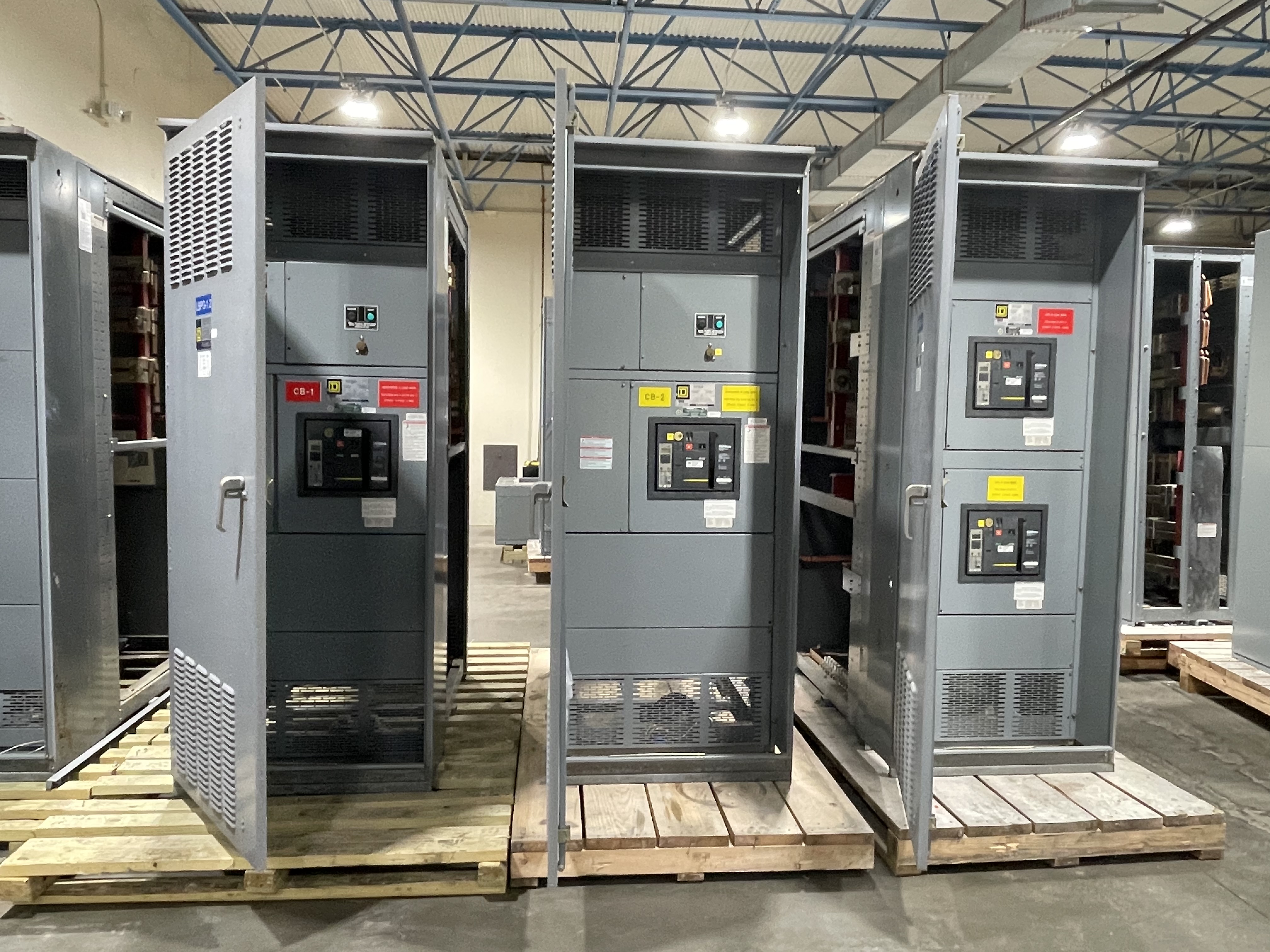
What a used switchboard buyer needs to know
A switchboard is usually a coordinated distribution assembly rather than a single loose device. The useful starting point is the lineup itself: count the sections, note whether sections are joined, and describe what is visibly present without removing covers. A main section, feeder sections, service equipment, metering compartments, distribution breakers, busway connections, or auxiliary sections can affect how the asset is evaluated. Do not guess when a label is faded. A clear photograph and a note such as unknown or unreadable are more useful than an inaccurate model number.
Exterior nameplates may show manufacturer, series, serial number, voltage, amperage, phase, wire configuration, interrupting rating, or a date code. Photograph each plate straight on, along with the full front of the lineup and any side or rear identification that is already accessible. Include a simple section-by-section count. If the switchboard has been separated, label each section in your photos so the relationship between pieces is clear. Breakers, doors, bus connections, metering components, trim, and hardware should be described as present, missing, loose, or unknown. This documentation helps us understand the lot without asking the seller to open or handle electrical equipment.
Ratings and condition without seller testing
We buy all voltage classes, so a low-voltage commercial switchboard and a higher-voltage industrial assembly can both be worth presenting for review. Voltage, current rating, phase, service designation, and breaker frame information matter, but they should come from existing labels or records rather than a seller's estimate. Age alone does not determine whether a switchboard is useful as a resale asset. Packaging, storage conditions, completeness, visible corrosion, water exposure, impact, modifications, and documentation all provide context. They do not need to be turned into a claim about operating condition.
No seller testing is required. Do not energize, troubleshoot, megger, reset, rack, or disassemble breakers for our review. Never open an energized enclosure or reach into a switchboard. Electrical isolation, verification, disconnection, and any required removal work must be handled by qualified personnel following the site's safety procedures. If equipment is still installed or connected, tell us that clearly; our team can plan qualified disconnects as part of the pickup rather than asking you to perform electrical work.
Useful information for a first review
- Manufacturer, series, serial number, nameplate ratings, and any readable model information.
- Number of vertical sections and a description of the main, feeder, distribution, or metering arrangement.
- Whether the switchboard is installed, disconnected, palletized, crated, or stored in pieces.
- Photos of accessible exterior faces, labels, doors, breakers, shipping marks, and storage conditions.
- Known missing components, modifications, water exposure, corrosion, or damage, stated plainly.
- The release date, site contact, access hours, floor or loading area, and any restrictions on trucks or lifting.
Switchboards from closures and large power projects
Equipment can become available when a data center is decommissioned, a power plant shuts down, or a hospital or campus closure changes how several buildings are used. In each case, the switchboard may be one lot within a larger transition. For a hospital closure, identify which electrical assets belong to the facility owner, a tenant, a utility, or a contractor, and coordinate access so clinical or building-safety obligations are respected. For a campus closure, separate buildings or phases when that makes the inventory easier to verify, and note whether equipment is spread across electrical rooms, storage areas, or multiple loading points. These are planning details, not assumptions about any particular Georgia site.
We buy the switchboards themselves; we do not require the seller to manage a demolition schedule. If a data center or power plant has already removed equipment, tell us how the sections are currently stored. If a lineup remains installed, our qualified personnel can coordinate disconnects and removal with the responsible site parties. The same approach works for a hospital or campus closure: establish ownership, identify a safe release window, and let us plan the equipment move around the site's access rules.
Full-service pickup and freight coordination
Switchboards are heavy, tall, and often awkward to move through an electrical room. A doorway dimension, stair, dock, overhead obstruction, turning area, or restricted delivery window can change the rigging plan. Share these constraints early, along with approximate dimensions if they are already available. You do not need to select a crane, hire a rigger, disconnect conductors, load a trailer, or arrange hauling. Our team handles crane and rigging coordination, qualified electrical disconnects, loading, freight, and hauling. We also coordinate practical pickup details with the designated site contact.
Seller responsibilities stay straightforward: confirm that you have authority to sell the equipment, provide honest information that is available without unsafe inspection, identify the release location, and make the site contact available for scheduling. Keep people clear of the work area and follow the facility's safety rules. Do not move an installed or energized switchboard for photographs or convenience. Qualified personnel handle electrical work and lifting decisions. Once the offer is accepted and pickup details are confirmed, we pay upfront and take care of the logistics rather than leaving you with a partially arranged shipment.
Request a cash offer for your switchboard
Send the exterior photos, readable labels, section count, condition notes, and access information you have. A missing manual or uncertain rating does not prevent an initial conversation; simply identify the uncertainty. We can review used, surplus, and decommissioned switchboards from replacement projects, facility closures, data centers, power plants, hospitals, campuses, and industrial locations across Georgia. After review, we provide a cash offer for consideration. There is no requirement for seller testing, and freight is covered. If the offer works for your situation, we coordinate the qualified removal and full-service move so you can clear the asset and get paid without taking on electrical or rigging work.