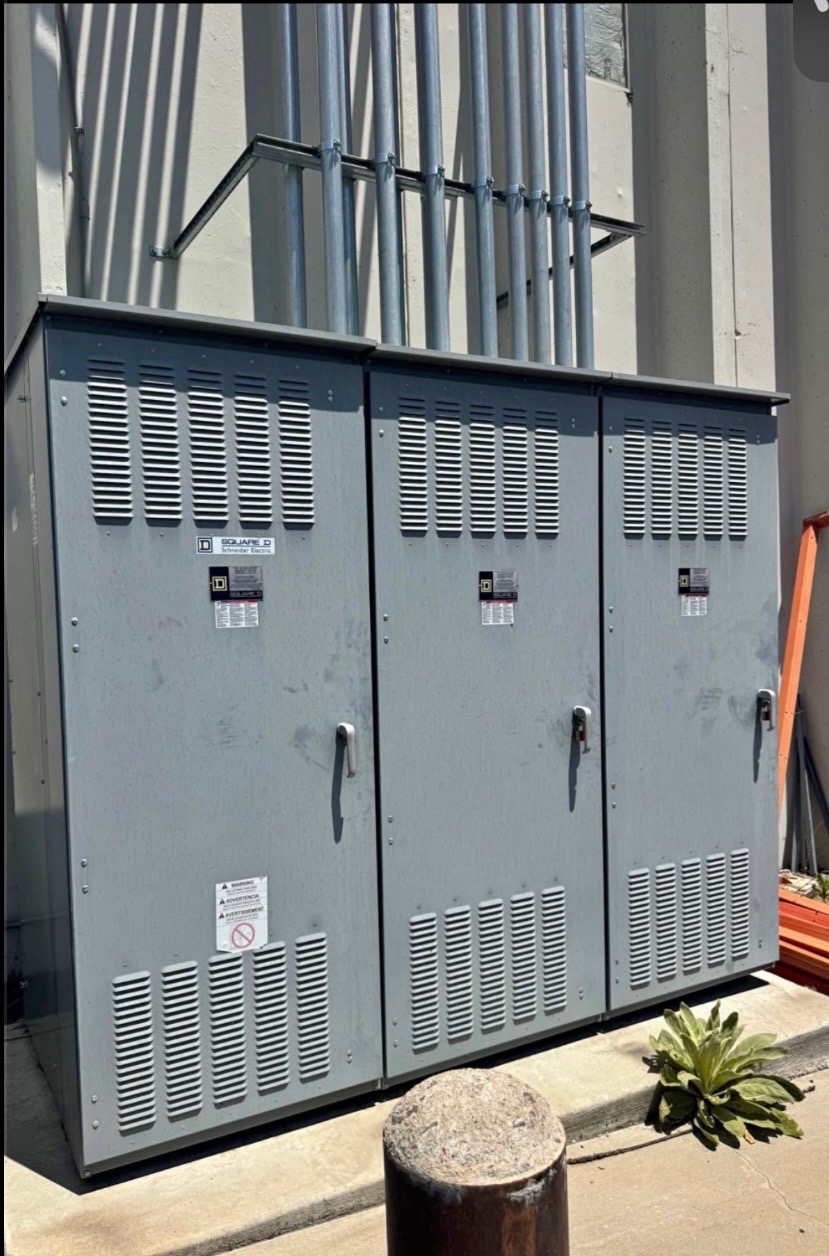
Start with the assembly nameplate, not a rounded voltage label
Transcribe the assembly nameplate exactly, including manufacturer, catalog or identification numbers, voltage wording, frequency, current or bus ratings, and any other printed designation. Preserve punctuation and units: “600 V” is not necessarily interchangeable with a nearby device marking, and a nominal system voltage is not itself a complete description of the assembly. If a plate is worn or partly obscured, record what is legible and note the uncertainty rather than completing the text from memory. A safely accessible exterior photograph can supplement transcription, but never approach or handle equipment to obtain one.
Keep system nominal voltage separate from device ratings
A nominal 600 V system designation and a starter or protective device’s marked voltage rating answer different questions. Record each in its own field and do not treat a device rating as proof of the connected system’s nominal voltage, or vice versa. For example, if the assembly plate says “600 V” while a visible starter marking shows another voltage value, preserve both exact markings and flag the difference for assessment. Do not conclude from that difference that the equipment is suitable, unsuitable, compatible, or incomplete; configuration and application cannot be established from two labels alone.
Inventory buckets and starters as individual components
Document the count of installed buckets separately from the count of spare buckets, and distinguish both from the number of starter units you can identify from safe exterior views. Record markings on each accessible bucket or starter individually, rather than assuming every unit matches the assembly plate or another compartment. A listing such as “six installed buckets; two spare buckets; markings recorded on four visible units” is more useful than “eight-bucket 600 V starter gear.” Where a marking cannot be read safely, identify that unit as unrecorded. Do not remove a bucket or open equipment to improve the inventory.
Describe what is present without assigning a configuration
Use neutral observations for lineup sections, doors, visible labels and apparent completeness; avoid naming a control arrangement unless documentation clearly supports it. A seller might see several marked starter buckets and a separate spare bucket, but that alone does not establish how the assembly was configured, which positions were active, or whether components belong together. Capture available bills of material, drawings or maintenance records as separate documents, identifying their date and whether they appear to correspond to the specific assembly. Treat discrepancies between records and visible markings as questions for review, not grounds to assume a particular build or compatibility.
Make safe documentation useful to an individual assessment
Share exact transcriptions, known spare-bucket count, general condition observations and relevant records, while labeling estimates as estimates. Photographs should be limited to safely accessible exterior nameplates and equipment from authorized safe positions; do not operate, open, touch, approach, test, disconnect, remove, rack out, move or handle energized equipment, even to obtain better images. Electrical work and any access requiring it belong to qualified, authorized personnel working under site rules. No seller testing or equipment preparation is required. If a detail is unavailable without electrical work or unsafe access, state that plainly instead of trying to supply it.
Set boundaries around price and acceptance
Exact ratings and a careful inventory help frame review, but they do not determine a price or guarantee acceptance. Assessment is individual and may consider the assembly and its components as documented; neither a 600 V nameplate nor a count of spare buckets establishes value, demand, condition or fit. This buyer purchases used, surplus and decommissioned electrical equipment across all voltage classes, including equipment from decommissioned data centers and shut-down power plants. Cash offers are made for assessed equipment, with payment upfront when a purchase is agreed; no particular offer or outcome should be presumed from the markings alone.
Clarify removal and transport responsibilities before a sale
If equipment is acquired, the buyer covers freight, crane, rigging, disconnects, loading and hauling, with arrangements assessed for the specific equipment and site. Sellers do not need to hire crews, perform tests or prepare the assembly. Any electrical disconnect or other electrical work must be performed by qualified, authorized personnel under applicable site rules; this does not authorize anyone to handle energized gear. Before discussing logistics, confirm ownership or authority to sell, identify access constraints and share known dimensions or site requirements only when safely documented. Removal arrangements, like rating interpretation, are evaluated case by case.