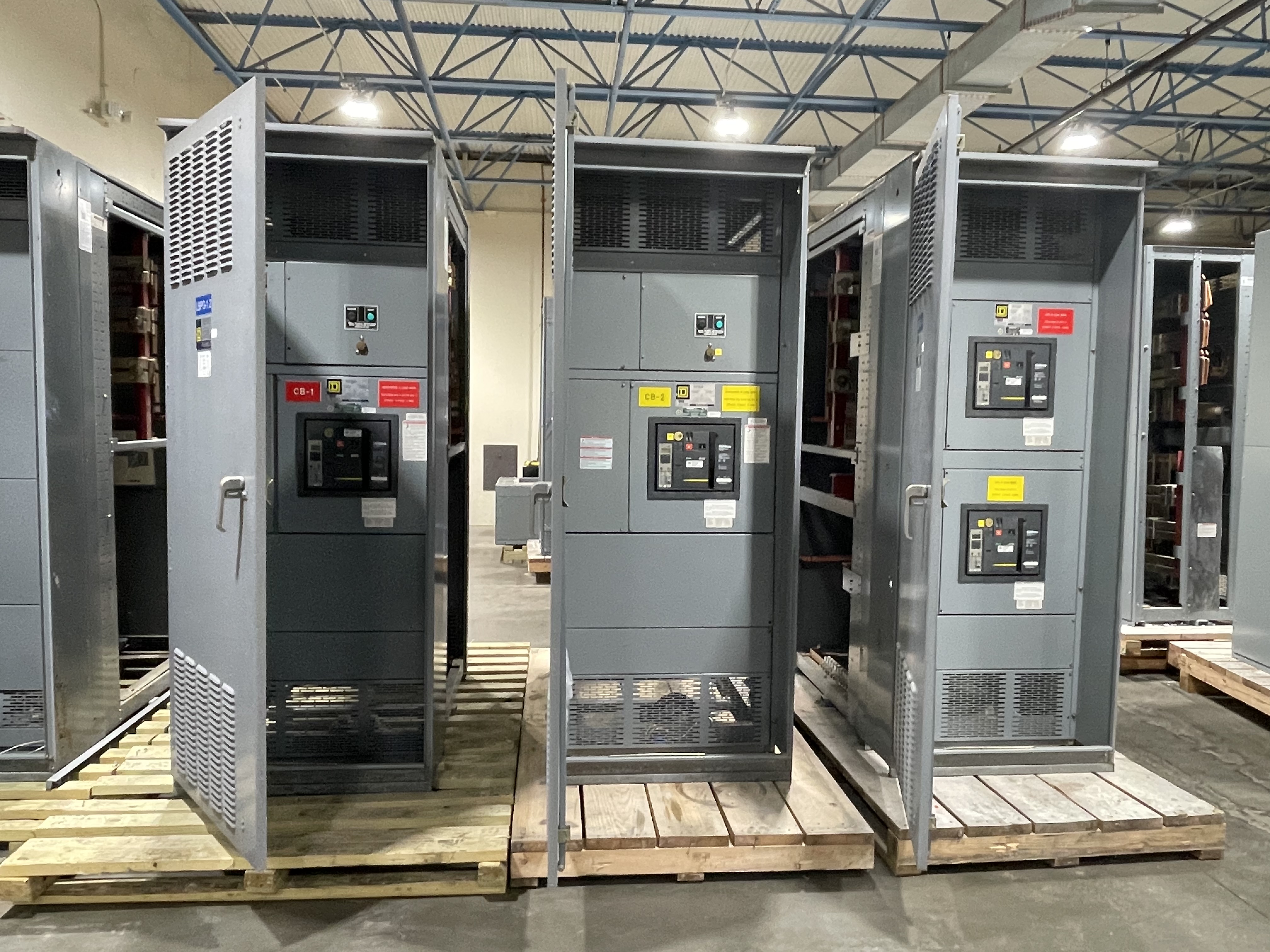
Start with the equipment in front of you, not the old one-line
A one-line is useful context, but an outdated drawing should not decide which gear is offered or how it is identified. Compare its labels and lineup references with the equipment’s exterior markings, noting where the drawing names a different manufacturer or omits a section. For example, an Eaton-marked breaker may be installed in an assembly carrying another maker’s label; that does not establish the assembly’s manufacturer or the breaker’s complete identity. Record the discrepancy instead of choosing one document as authoritative. An independent buyer can review the inventory as it exists and assess assets individually.
Separate assembly identity from component markings
“Eaton” on a visible nameplate identifies a marking to report, not proof that every part of a lineup is Eaton equipment. Distinguish the switchgear or switchboard assembly, individual breakers, bus, frames and trip units in the inventory notes. A breaker’s label does not establish the assembly maker, and a frame designation is not the same as a trip designation. Capture each legible exterior marking separately, including manufacturer, catalog or serial identifiers when visible. Do not infer an unmarked component’s identity from an adjacent label. This precision helps prevent mixed assets from being represented as a single branded package.
Document ratings without filling gaps by assumption
Distribution equipment may show several distinct ratings, including nominal voltage and ratings associated with the assembly or an individual breaker. Record only what is legible on exterior nameplates from an authorized safe position; keep a blank or “uncertain” entry where information is missing. Do not copy a value from the old one-line onto equipment when the labels conflict. If a rating matters to the buyer’s assessment, flag the conflict for review rather than asking the seller to test or open equipment. An assessment of mixed-voltage assets is individual; buying across voltage classes does not establish compatibility or acceptance of a particular item.
Resolve ownership before treating the inventory as available
At a shutdown or acquisition, equipment may belong to the facility, a tenant, a lender, a leasing company or another party. A nameplate identifies a manufacturer marking, not the owner. Match each offered asset to available ownership records, sale authority or the appropriate internal approval, and separate items whose status is unresolved. If the one-line includes equipment outside the seller’s control, do not assume that its appearance in a drawing makes it part of the sale. The seller must own the equipment or have authority to sell it. Clear boundaries protect both parties from including assets that were not authorized for transfer.
Make a useful inventory without testing or handling gear
A practical inventory can be built from existing records and exterior observations: lineup or room reference, equipment type, visible manufacturer markings, legible exterior nameplate details, apparent quantity and any mismatch with the drawing. Photographs should show only equipment exteriors and exterior nameplates safely visible from an authorized safe position. Do not approach, open, touch, operate, test, disconnect, rack out or move energized equipment to improve documentation. Seller testing and seller preparation are not required. Any electrical inspection or other technical electrical work must be performed by qualified, authorized personnel under the site’s rules.
Compare offers against the actual mixed inventory
Once identities and sale authority are clearer, provide the inventory and note uncertainties so the buyer can assess each asset individually. An independent buyer purchases used, surplus and decommissioned electrical equipment, including equipment identified by Eaton markings, without claiming affiliation with a manufacturer. Cash offers are paid upfront for an agreed purchase; price and acceptance depend on the individual assessment, not merely a brand name or an obsolete drawing. The buyer considers all voltage classes, but that is not a promise to accept every item or a statement that components are interchangeable. Ask which listed assets are included in any offer.
Define removal scope and who pays for it
If an agreed purchase includes removal from a site in Duluth, confirm the asset boundaries, access conditions and responsibilities before scheduling work. The buyer covers agreed crane, rigging, disconnects, loading, freight and hauling as applicable to that purchase; the seller is not required to hire or pay a removal crew. Electrical disconnect work must be performed by qualified, authorized personnel in accordance with site rules. Clarify what equipment is included and what remains in place, especially where mixed manufacturers or an obsolete one-line leave boundaries uncertain. Removal scope does not imply unrelated demolition or hazardous-material remediation.