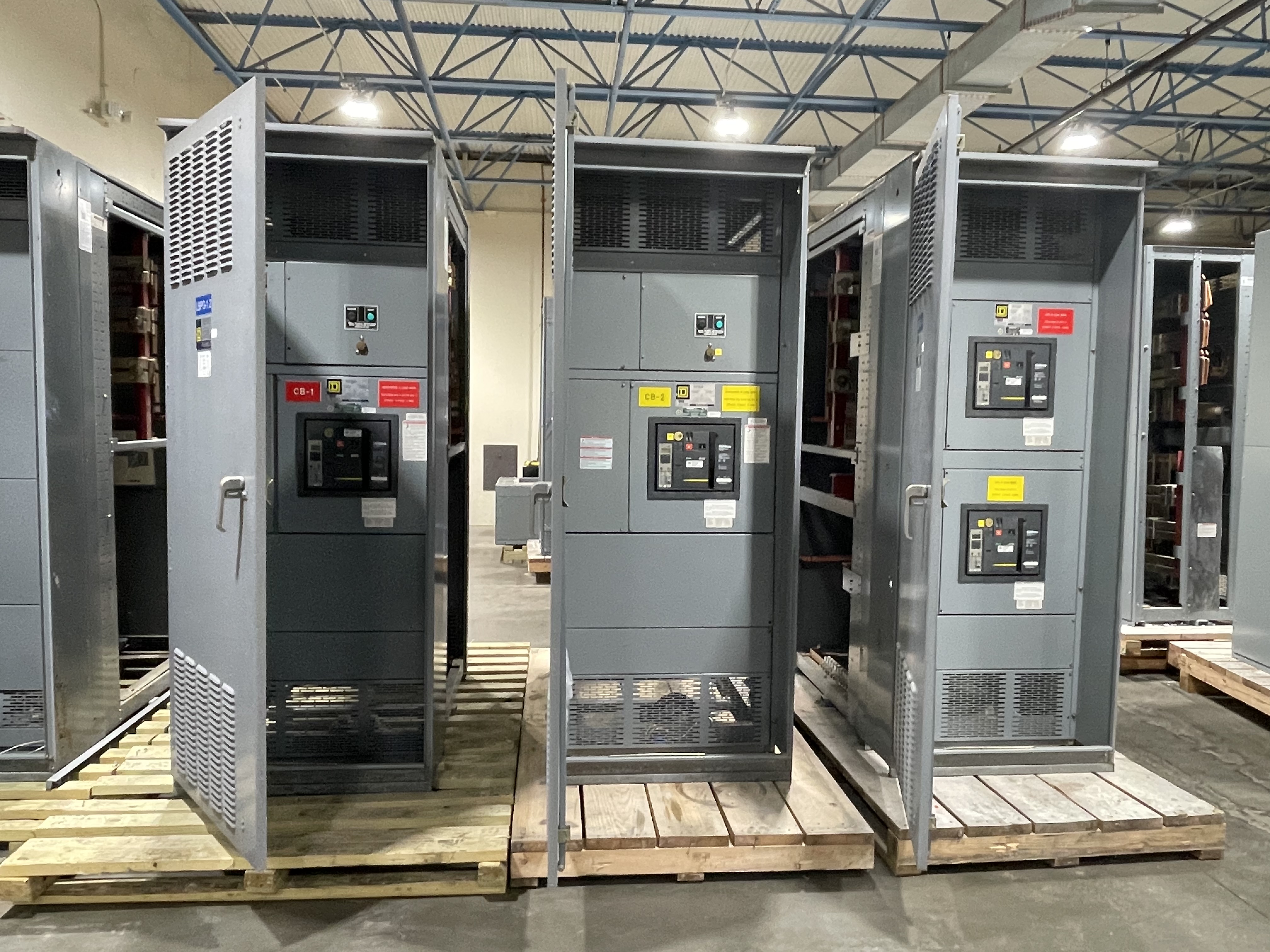
Start by separating assemblies, not by guessing from appearance
If a facility has switchgear associated with more than one voltage class, organize the inventory around identifiable assemblies rather than treating the room as one lot. A lineup may contain sections with different nameplates, or equipment added at different times; appearance alone cannot establish ratings or compatibility. Record each assembly’s visible identification and its location using a site-approved inventory method. Keep uncertain or unreadable labels marked as unknown instead of filling gaps from adjacent equipment. This separation helps a buyer assess what is actually being offered and reduces the risk of combining unlike assets in one description.
Keep voltage class separate from breaker current
A nameplate’s voltage rating describes a different characteristic from a breaker’s current rating. For example, a visible breaker label showing a current value does not establish the voltage class of the assembly it belongs to, nor does an assembly nameplate establish every installed device’s rating. Record these as separate fields only when each value is legible and safely accessible. Do not infer missing values from the size of a breaker, its position, a neighboring section, or a remembered one-line diagram. If the distinction is unclear, note the uncertainty for review rather than assigning a specification.
Build an inventory that preserves uncertainty
A useful inventory can identify assembly, manufacturer name as visibly marked, nameplate ratings, section count, and apparent completeness without claiming unverified technical details. If breakers are included, list them separately when they can be identified safely from existing records or authorized exterior views. Note whether labels are obscured, whether documentation is available, and whether the seller’s authority covers the full lot. This level of detail supports an individual assessment while avoiding an inaccurate promise that every component is compatible, functional, or acceptable. Ownership or documented authority to sell should be clear before equipment is offered.
Use safe photographs and existing records
Photographs can help clarify an inventory, but only capture exterior nameplates and equipment from positions that are already authorized and safe. Never approach, open, touch, operate, test, disconnect, move, or handle energized equipment to obtain a picture or read a label. Electrical access and any technical work belong to qualified, authorized personnel following site rules. Where a label cannot be safely viewed, use existing asset records if available and identify the source; do not create a new value by inference. A photo should document what is safely visible, not substitute for a technical inspection.
Decide how mixed equipment should be offered
Separate offers by assembly or clearly defined group can make sense when voltage classes, completeness, or documentation differ. A combined offer may be simpler when the seller wants one disposition, but it can leave less room to distinguish a well-documented lineup from sections with missing identification. Neither approach guarantees acceptance or a particular price: assets and offers are assessed individually. Ask whether the buyer wants separate inventory lines, which records would help clarify the lot, and how uncertain or incomplete sections should be represented. Do not describe a mixed group as uniform when its ratings or contents have not been verified.
Coordinate payment and removal responsibilities
The buyer purchases used, surplus, and decommissioned electrical equipment for cash and pays upfront, subject to an individual assessment and agreed transaction details. Seller testing is not required, and equipment across all voltage classes may be considered; that does not imply every item will be accepted. For an agreed purchase, the buyer covers freight and hauling as well as crane, rigging, disconnects, and loading. Confirm scope and access arrangements before scheduling. Electrical disconnects and other technical work must be performed by qualified, authorized personnel under site rules; the seller is not asked to test or prepare equipment.
Set pickup conditions around the actual site
If an Oconee County pickup involves several assemblies, clarify which items are included, where they are situated, and what site access constraints authorized personnel should know. Share applicable check-in, work-hour, loading-area, and safety requirements without assuming a particular facility layout. Identify any sections that must remain in place or whose ownership is uncertain. The buyer can then assess removal logistics alongside the equipment, but no pickup date or outcome should be assumed before scope and arrangements are reviewed. Do not undertake removal or handling yourself; leave electrical and rigging work to the qualified personnel responsible for those tasks.