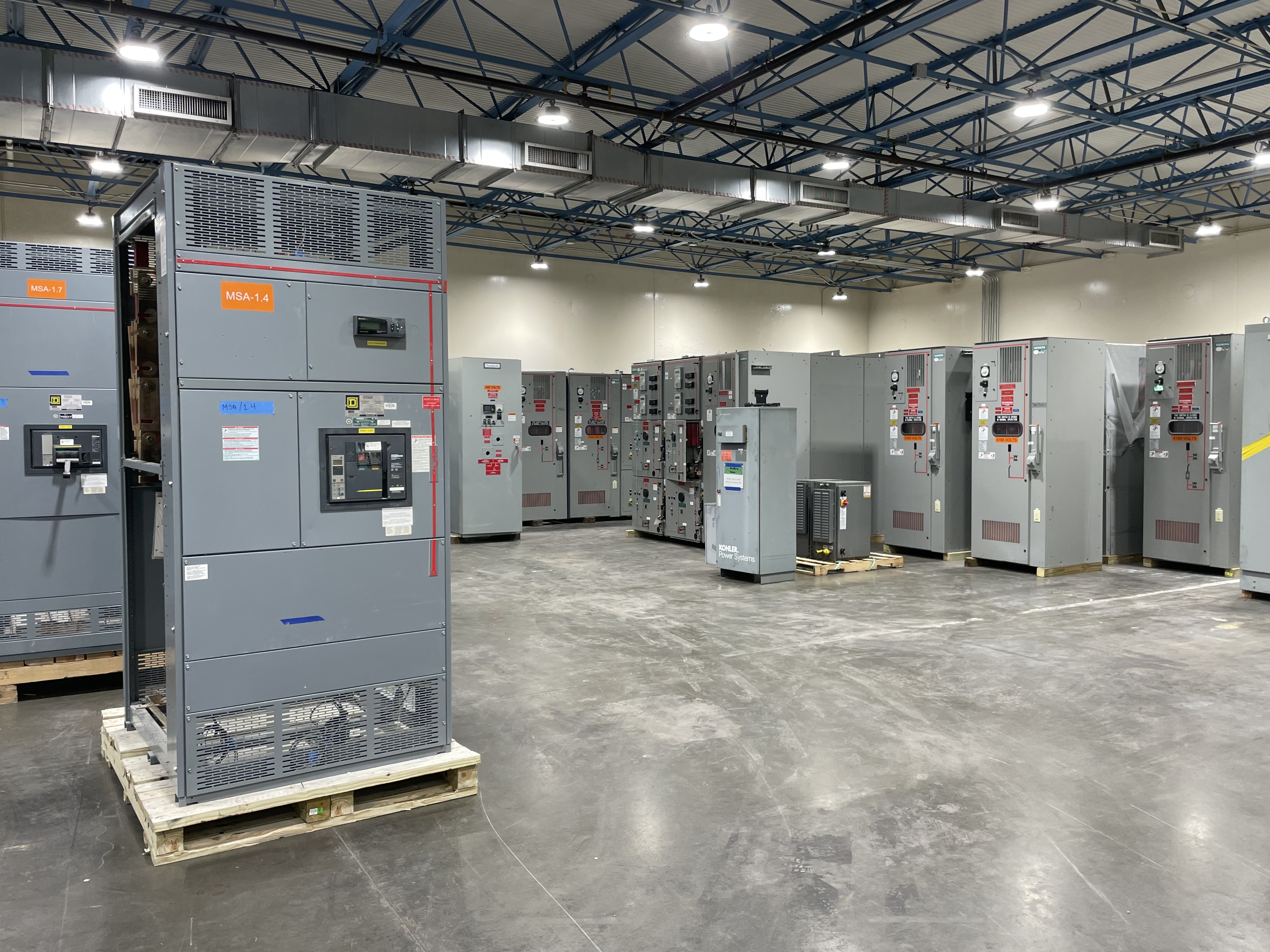
Map the overhead constraint before evaluating removal
Start with the space above and around the MCC, not an assumption that a standard lift will fit. A mezzanine may limit vertical clearance, while beams, piping, cable tray, lighting, or stored items can affect a proposed route. Record measured clearances and route dimensions only through personnel authorized to make those observations safely; note where each measurement begins and ends. Include door openings, turns, floor transitions, and the distance from the equipment to a loading point. Do not shift stored material or approach electrical equipment to get measurements. These details help a buyer and qualified removal professionals judge whether rigging options are practical without asking the seller to stage the MCC.
Separate equipment identification from visual condition
MCCs are assembled lineups, so a single nameplate may not describe every section or installed component. Gather available purchase records, drawings, lineup schedules, and maintenance documentation, and list visible exterior nameplate information by section when it can be read from an authorized safe position. Photos should show only the exterior and nameplates safely visible from that position; do not open doors or remove covers. Distinguish the MCC assembly from individual motor-control units, breakers, and other components. Record apparent gaps or later additions as observations, not proof of compatibility or completeness. This gives a buyer a clearer basis to assess the particular inventory without inventing a configuration from one label.
Clarify ratings without treating unlike labels as equivalents
Before discussing an offer, compare documented system voltage and lineup ratings with the information on individual components, where available. An MCC assembly rating, a breaker rating, a unit frame size, and a trip rating refer to different things; none should be substituted for another. A trip value alone does not establish the assembly’s rating, and a matching voltage label does not prove that sections or units are compatible. Ask what records support each stated value and flag missing or conflicting documentation. The buyer considers equipment across all voltage classes, but each asset is assessed individually. Sellers do not need to test the MCC: no seller testing is required, and no conclusion should rest on an unverified assumption.
Evaluate access and rigging as part of the purchase
With a mezzanine overhead, removal may call for a rigging plan that accounts for lifting height, load path, equipment weight information, and the route to the loading area. Share existing weight records if available, but do not estimate by moving or handling the lineup. The buyer covers agreed removal services, including crane, rigging, electrical disconnects, loading, freight, and hauling as applicable to the purchase; the seller is not expected to hire or pay a removal crew. Electrical disconnects and related electrical work must be performed by qualified, authorized personnel under site rules. Whether a particular method or purchase is workable depends on the documented conditions and an individual assessment, not a guaranteed lift plan.
Prepare a safe, useful information package
A concise package can help resolve uncertainty without seller preparation. Include an inventory of lineup sections, available drawings and records, approximate overall dimensions if already documented, known access restrictions, and the route description. Add exterior photos only when the equipment and nameplates are safely visible from an authorized position; never approach, open, test, disconnect, or move energized equipment to create better images. Identify unknowns plainly instead of filling gaps with guesses, especially for weight, internal contents, ratings, or later modifications. If the MCC serves a decommissioned data center or shut-down power plant, note that context and any available asset records. Ownership or authority to sell must also be established before a transaction proceeds.
Compare the offer with the actual scope
Once the buyer has reviewed the available information, ask what inventory is included, what removal services are covered in the proposed purchase, and which access details remain uncertain. The buyer makes a cash offer and, if the purchase is agreed, pays upfront; acceptance, price, schedule, and removal approach depend on individual assessment and agreed terms. For an MCC beneath a mezzanine, a lower apparent equipment value may not settle the decision if constrained clearance changes the removal scope. Conversely, clear documentation may reduce uncertainty without changing the physical obstacle. Carrollton may be the pickup locality if the equipment is there, but the location alone does not establish feasibility. Keep site access and safety rules in force throughout evaluation and removal.